In the competitive world of furniture manufacturing, kitchen cabinetry, and commercial interior fit-outs, specifiers and procurement professionals face a persistent challenge: sourcing panels that combine structural integrity with a ready-to-use decorative finish—without the cost and complexity of post-production lamination. For decades, this meant specifying raw plywood and then outsourcing a separate laminating step, adding time, cost, and quality variability.
Melamine Faced Plywood (MFP)—also known as melamine plywood, melamine laminated plywood, or ecological board—has solved this equation. By thermally fusing decorative melamine paper directly to a load-bearing plywood core in a single manufacturing process, MFP delivers a panel that is strong enough to hold hinges and shelves, beautiful enough to serve as a finished surface, and cost-effective enough for high-volume production runs.
According to IndexBox analysis, the global Melamine Faced Plywood Board market is projected to maintain steady compound annual growth from 2026 to 2035, anchored in the material‘s entrenched position as a versatile substrate for furniture, cabinetry, and interior paneling, offering structural integrity from the plywood core combined with a pre-finished decorative surface that reduces on-site labor and finishing costs. A separate analysis of the premium melamine faced birch plywood segment valued the global market at USD 2.75 billion in 2024, with projections reaching USD 4.18 billion by 2032 at a CAGR of 4.5%.
At XILU, we manufacture melamine faced plywood to international standards for furniture brands, construction firms, and distributors worldwide. Explore our full catalog of Decorative Surfaces, including standard and custom melamine plywood options.
What Is Melamine Faced Plywood?
Melamine Faced Plywood is an engineered panel created by taking a structural plywood core—typically composed of cross-laminated poplar, eucalyptus, or hardwood veneers—and thermally bonding resin-impregnated decorative paper onto one or both sides under extreme heat and pressure. This is classified as a Low-Pressure Laminate (LPL) process, distinct from High-Pressure Laminate (HPL) which is pressed at over 1,400 psi.
Melamine board—as we explain in our foundational overview—is a type of laminated panel made by fusing a melamine resin-impregnated decorative surface onto a substrate such as particleboard, plywood, or MDF under high pressure. When that substrate is cross-laminated plywood rather than particleboard, the result is a panel that marries two distinct performance characteristics:
- The Core (Structural Strength): Multi-layer cross-laminated veneers provide exceptional resistance to warping, cracking, and structural deflection. The screw-holding power of plywood far outperforms particleboard and MDF cores, making MFP the preferred choice for hinge-intensive cabinetry.
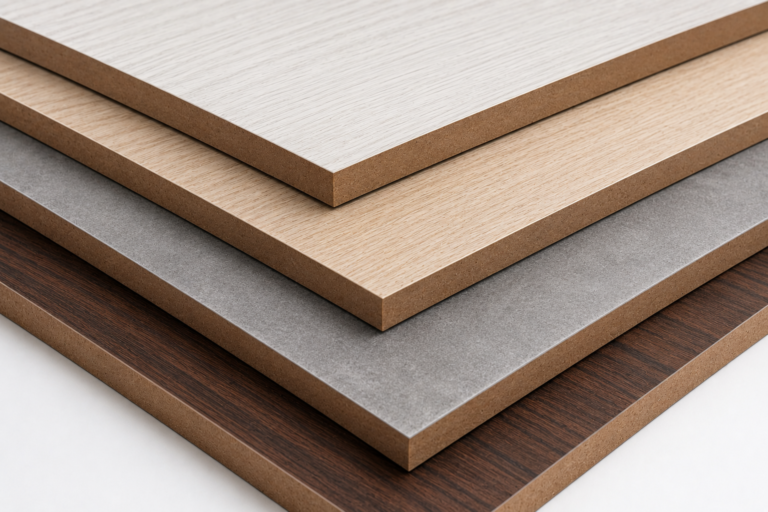
- The Surface (Beauty & Protection): Cured melamine resin forms a non-porous barrier that resists scratches, stains, heat, and moisture. Available in solids, wood grains, and textured synchronized embossing-in-register finishes, MFP panels arrive finished and ready for fabrication.
Our Wood Grain Melamine Plywood product page provides detailed specifications on available surface textures, thickness ranges (5mm to 35mm), and core material options, including poplar, eucalyptus, pine, and hardwood.
The Manufacturing Process: Direct Pressing vs. Indirect Pressing
The manufacturing process of melamine plywood involves two primary techniques, each with distinct production steps and quality control considerations:
- Direct Pressing: In this method, melamine-impregnated decorative paper is directly hot-pressed onto the finished plywood substrate at high temperature (approximately 130°C to 150°C) for 20 to 40 minutes. The melamine resin melts, flows, and polymerizes, creating a chemically bonded surface layer. Direct pressing is a single-step process that requires precise temperature and pressure control to prevent premature curing or inadequate bonding—but delivers excellent adhesion when properly executed.
- Indirect Pressing: This two-step approach first presses melamine paper onto a thin veneer or overlay sheet, then bonds that pre-laminated sheet to the plywood core in a secondary pressing. While more labor-intensive, indirect pressing can offer greater control over surface appearance and is sometimes preferred for texturally complex finishes.
The quality of the finished product depends heavily on the precision of the hot-press cycle and the quality of the impregnating resin. Premium manufacturers use high-quality melamine-formaldehyde resin adhesives and maintain tight tolerances on temperature uniformity, dwell time, and pressure distribution to ensure consistent bond strength across each full sheet.
6 Key Advantages That Make Melamine Faced Plywood the Smart Specification
1. Pre-Finished, Production-Ready Surface
Perhaps the single most compelling advantage is that MFP arrives ready to cut, edge-band, and assemble—saving one or two post-processing steps. For furniture manufacturers producing hundreds or thousands of units, this eliminates the cost, lead time, and quality variability of applying laminate or paint post-production. Our Melamine Board guide details the broad spectrum of available colors, textures, and finish options.
2. Structural Load-Bearing Integrity
When shelves must hold books, countertops must support appliances, and cabinet doors must swing on hinges for decades, the substrate matters. Plywood cores provide significantly higher screw-holding capacity than MDF or particleboard. The cross-laminated structure also delivers exceptional dimensional stability—boards resist warping, twisting, and deflection under load. For a detailed comparison of plywood types and their structural characteristics, consult our High-quality Plywood Selection Guide.
3. Durability for High-Use Environments
The cured melamine surface offers remarkable functional performance: it is scratch-resistant, water-repellent, stain-resistant, and heat-resistant. It resists abrasion from general acids, alkalis, grease, and alcohol. These properties make MFP ideal for high-moisture areas like kitchens and bathrooms.
4. Hygienic and Easy to Maintain
The dense, non-porous surface does not trap bacteria, food particles, or cooking odors. Routine cleaning requires only a damp cloth—no specialized chemicals or treatments. This combination of durability and hygiene has made MFP a preferred specification for healthcare cabinetry, laboratory casework, and commercial food-service installations.
5. Wide Design Versatility
Melamine boards are available in hundreds of colors, patterns, and textures—including remarkably realistic wood grain reproductions—providing virtually unlimited design possibilities. Whether the project calls for solid white cabinetry, matte woodgrain shelving, or high-gloss display panels, there is a production-ready MFP specification to match. For solid-color applications, our White Melamine Board 16mm product page provides details on finish options including glossy, matte, embossed, and stipple.
6. Cost-Effectiveness Across the Lifecycle
Melamine plywood is more affordable than solid wood, with no need for additional sanding, staining, or sealing—reducing labor and material costs at every stage of fabrication. When analyzed on a total-cost-of-ownership basis—factoring in faster assembly, reduced waste, fewer finishing steps, and long service life—MFP consistently outperforms multi-material panel solutions.
Plywood Core vs. Other Substrates: Why the Base Matters
Not all melamine-faced panels are functionally interchangeable. The core material determines the panel’s structural behavior, fastener holding, and moisture resilience:
| Core Type | Screw-Holding | Moisture Durability | Weight | Best For |
|---|---|---|---|---|
| Plywood | Excellent | High (when sealed) | Moderate | Cabinetry, shelving, structural panels |
| MDF | Good | Low-Medium | Heavy | Painted finishes, detailed routing |
| Particleboard | Fair | Low | Moderate | Budget cabinets, low-stress shelving |
Plywood delivers significantly higher screw-holding capacity for hinge-intensive cabinetry and shelving that will bear substantial weight. For a thorough breakdown of plywood’s structural properties and grading standards, refer to our comprehensive Plywood guide.
Broad-Spectrum Applications Across Industries
Melamine Faced Plywood‘s unique combination of structural integrity and pre-finished beauty positions it for a remarkably wide range of end uses:
- Kitchen & Bathroom Cabinetry: Water-resistant, easy to clean, and capable of holding heavy countertop loads. The combination of durable surface and moisture-tolerant core makes MFP the default specification for mid-to-high-end cabinet boxes, doors, and drawer fronts.
- Furniture Manufacturing: From RTA (ready-to-assemble) furniture to high-end custom wardrobes, MFP provides a manufacturer-ready surface that accelerates production while maintaining consistent appearance. The decorative finish arrives complete—eliminating secondary painting or laminating stations.
- Office and Commercial Desking: The high strength-to-weight ratio and availability of matte, anti-fingerprint, and woodgrain finishes make MFP suitable for large workstations and open-plan office systems where structural rigidity and aesthetic consistency matter equally.
- Retail Fixtures and Display Systems: The availability of FSC-certified variants and a broad palette of surface textures meets the sustainability and aesthetic demands of high-end retail environments, while the wipe-clean surface simplifies ongoing maintenance in display-heavy spaces.
- Shelving Systems: For closets, pantries, bookcases, and built-in storage, the plywood core ensures loaded shelves resist sagging over spans that would cause particleboard to deflect.
- Children’s Furniture: Given E0/ENF-grade formaldehyde standards achievable in modern MFP production, the material is a preferred choice for nursery furniture and children’s storage units where safety is the primary concern.
For technical guidance on selecting the right panel for a specific application, our Melamine Boards overview page catalogs the full product range by substrate, thickness, surface type, and intended use.
Installation and Fabrication Best Practices
To achieve professional results and protect the panel‘s integrity:
- Cutting: Always use a fine-tooth saw blade—typically 80-tooth TCG carbide—or a saw with a scoring unit. Applying masking tape along the cut line can minimize surface chipping. As one industry guide notes, precision installation is key: improper cutting or installation may cause chipping, so professional tools are advised.
- Edge Banding: The raw cut edge is the panel’s vulnerability point. Applying matching PVC, ABS, or melamine edge banding creates a professional finished appearance, seals the plywood core against moisture ingress, and prevents the formaldehyde from the interior from volatilizing. At XILU, we manufacture edge banding products in our own factory, with colors achieving 99% similarity to the corresponding board surface. For more information on edge banding types—including PVC, ABS, and melamine options—visit our dedicated Edge Banding page with full specification catalogs.
- Fastening: Use coarse-thread screws designed for plywood end-grain anchoring, which dramatically outperforms fasteners designed for MDF or particleboard in pull-out resistance.
- Moisture Management: While the melamine surface is water-resistant, prolonged water exposure can damage the core material through unsealed edges or surface breaches. Unfinished edges require quality edge banding for protection and aesthetics.
Market Trends Shaping the MFP Industry
Several trends are reshaping the global MFP landscape:
- Urbanization and Renovation Cycles: Construction recovery and urbanization trends directly influence MFP demand, as the material serves as a primary substrate in kitchen cabinets, built-in wardrobes, and interior paneling for new residential and commercial projects worldwide.
- Shift Toward Higher-Performance Variants: The market is seeing a gradual shift toward value-added products that deliver specific performance characteristics—including fire-retardant and moisture-resistant grades, particularly for commercial and public sector projects.
- Sustainability as a Procurement Driver: FSC-certified variants now represent over 35% of new installations in exhibition spaces and retail fit-outs globally. The post-pandemic emphasis on hygienic surfaces has also increased specification of wipe-clean melamine finishes in healthcare and education sectors. Premium MFP products can achieve E0/ENF-grade formaldehyde emission levels, meeting the strictest global indoor air quality standards and contributing toward green building certifications.
- Supply Chain Resilience and Regional Diversification: Manufacturers are adapting to a more regionally diversified supply architecture, with growth in Asia-Pacific production capacity supplemented by emerging production hubs in Latin America and the Middle East.
Quality Certifications: What Global Buyers Should Demand
Reputable MFP suppliers should hold internationally recognized certifications:
- FSC (Forest Stewardship Council): Independent verification of responsible forest sourcing and chain-of-custody traceability.
- CARB P2 & EPA TSCA Title VI: North American regulatory benchmarks for ultra-low formaldehyde emissions.
- ENF Grade: The world‘s most stringent formaldehyde-emission standard (≤ 0.025 mg/m³), the highest classification under China’s GB/T 39600-2021.
- CE Marking: Required for structural wood panels sold in the European Economic Area, confirming compliance with health, safety, and environmental protection standards.
- ISO 9001 & ISO 14001: Quality management and environmental management systems accreditation.
XILU holds ISO 9001, ISO 14001, CARB, CNAS, FSC, and IAF certifications, ensuring our melamine faced plywood consistently meets the most demanding global safety, quality, and environmental benchmarks. For detailed technical documentation and comprehensive answers to common buying, handling, and fabrication questions, explore our FAQ on Wood-Based Panels section.
Why Source Your Melamine Faced Plywood from XILU?
As a Professional China Plywood and Melamine Board Manufacturer & Supplier, XILU is more than a source for panels—we are an extension of your supply chain and quality assurance team, dedicated to reliable product delivery that meets your project’s specification requirements.
What We Deliver:
- Scale & Reliability: 25 years of melamine board manufacturing expertise, 60+ production lines spanning numerous product categories, and export experience serving over 100 countries and 1,000+ customers worldwide.
- Customization: Thickness from 2.0mm to 35mm, standard and custom panel sizes, multiple core material options (poplar, hardwood, eucalyptus, pine), and a full palette of melamine colors spanning solid colors, wood grains, and custom design requests.
- Integrated Edge Banding: Matching PVC, ABS, acrylic, and melamine edge banding produced in our own facility—with 99% color fidelity guarantees—so your finished product presents a seamless, professional appearance.
- Certification Confidence: Every shipment backed by FSC, CARB, ISO, and CNAS certification documentation for supply chain transparency and import compliance.
- Value: Factory-direct pricing with volume-based wholesale rates that help protect your project margins.
Ready to discuss specifications, request physical samples, or negotiate a bulk factory-direct quotation?
👉 Contact XILU Project Team Now — or browse our full Product Center for a complete view of our melamine plywood, decorative surfaces, and engineered wood solutions.
Frequently Asked Questions
1. What‘s the difference between melamine faced plywood and melamine faced MDF?
The core. Plywood uses cross-laminated wood veneers, providing substantially higher screw-holding power and lighter weight—making it the superior choice for cabinets requiring strong hinge anchorage. MDF delivers a smoother, denser surface suitable for detailed routing or painted finishes, but it is heavier and more susceptible to screw stripping under repeated load.
2. Is melamine plywood waterproof?
The melamine surface is water-resistant, not fully waterproof. The surface itself repels water, but prolonged moisture exposure through unsealed edges can affect the plywood core. For bathrooms and high-humidity areas, specify moisture-resistant (MR) or phenolic glue cores and ensure all cut edges are properly sealed with matching edge banding.
3. How environmentally safe is melamine faced plywood?
Premium MFP products produced with E0 or ENF-grade adhesives release negligible formaldehyde—meeting the strictest indoor air quality standards globally. Many modern formulations carry FSC certification for responsible forestry and contribute to LEED and BREEAM credits. Always verify a supplier’s current certification documents rather than relying on verbal assurances.
4. What thickness should I specify?
Common thicknesses range from 5mm to 35mm. For cabinetry carcasses and shelving, 15-18mm is standard. For countertops and heavy-duty structural applications, 21-25mm provides the necessary load-bearing capacity. For decorative panels and lightweight applications, 5-12mm may suffice. Our Melamine Plywood FAQ Collection provides additional guidance on thickness selection for specific use cases.
5. How do I verify a manufacturer‘s quality before ordering?
Request physical production samples prior to shipment to evaluate surface finish quality, color accuracy, and cross-section inspection for core uniformity. Confirm certifications (FSC, CARB, ISO) with current documentation. For bulk orders, specific quality inspection checkpoints and test reports—including formaldehyde emission testing, bond strength results, and dimensional tolerance verification—should be established before production begins.
6. Does melamine faced plywood require edge banding?
Yes. All exposed cut edges must be sealed with appropriate edge banding (PVC, ABS, or melamine) to prevent moisture ingress and complete the professional aesthetic. Unfinished edges are vulnerable to moisture damage and also allow formaldehyde from the interior to volatilize. XILU provides matching edge banding solutions with 99% color similarity guarantees.
7. Can melamine plywood be used for commercial projects?
Yes, and it frequently is—for office furniture, retail fixtures, hospitality cabinetry, and institutional casework. For commercial specifications, verify that the selected product meets applicable fire-retardant, moisture-resistance, and VOC emission standards for the project‘s jurisdiction and building type. The market is increasingly seeing a shift toward fire-retardant and moisture-resistant grades for commercial and public sector projects.